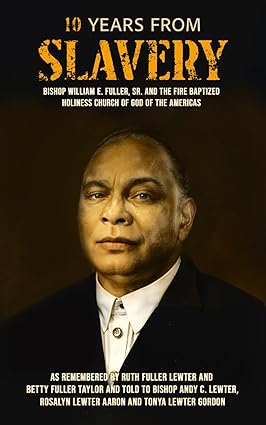
By Bishop Andy C. Lewter, Rosalyn Lewter Aaron, and Tonya Lewter Gordon
In an era when African American religious history often remains relegated to footnotes in broader historical narratives, “Bishop: The Story of William E. Fuller, Sr.” emerges as a vital contribution to our understanding of Black spiritual leadership, institutional building, and community empowerment in post-Reconstruction America. This deeply personal yet thoroughly researched family memoir transcends the typical boundaries of religious biography to offer readers a multifaceted portrait of a remarkable leader whose influence extended far beyond the pulpit.
A Story Born from Memory and Love
What immediately distinguishes this work is its intimate narrative voice. Written by Bishop Fuller’s grandchildren and drawing extensively from the preserved memories of their mother, Ruth Fuller Lewter, and aunt, Betty Fuller Taylor, the book reads less like a distant historical account and more like an extended family conversation around the kitchen table. This approach proves to be both the book’s greatest strength and its most compelling feature—we are not merely reading about Bishop Fuller; we are being invited into the living memory of his legacy.
The authors’ decision to structure the narrative around family stories and personal recollections creates an immediacy that academic histories often lack. When Aunt Betty describes her grandfather throwing his necktie in a ditch before entering a Fire-Baptized Holiness tent meeting, or when the family recounts the elaborate funeral preparations at their fourteen-room home on Houston Street, readers gain access to the texture of lived experience that statistics and formal records cannot provide.
Beyond the Individual: Institutional Vision
While the book centers on Bishop Fuller’s personal journey from orphaned sharecropper’s child to religious leader and successful businessman, its deeper contribution lies in documenting the systematic approach he took to building lasting institutions. The authors meticulously detail how Fuller transformed a small holiness movement into the Fire Baptized Holiness Church of God of the Americas, complete with sophisticated organizational structures, educational institutions, and economic foundations.
The book’s treatment of Fuller Normal Industrial Institute deserves particular praise. Rather than simply noting its existence, the authors explore how the school’s funding through the Sisters of Charity and Young People’s Institute conventions created a sustainable model for community-supported education. This attention to institutional mechanics helps readers understand how African American communities created and maintained their own educational systems during an era of systematic exclusion from mainstream institutions.
Complexity and Contradiction
One of the book’s most valuable contributions is its nuanced portrayal of African American religious leadership during the early twentieth century. The authors don’t present their grandfather as a flawless icon but as a complex figure who navigated competing demands and changing circumstances. His initial integration into a predominantly white holiness movement, followed by his decision to establish an independent Black denomination, illustrates the difficult choices faced by African American leaders seeking both spiritual authenticity and practical progress.
The book’s treatment of Fuller’s limited engagement with direct civil rights activism during the Harlem Renaissance and beyond provides important context for understanding different approaches to racial advancement. Rather than criticizing his focus on spiritual renewal over political engagement, the authors help readers understand how institution-building and community development represented their own forms of resistance and empowerment.
Economic Vision and Practical Faith
Perhaps the book’s most surprising revelation concerns Bishop Fuller’s extraordinary success as a real estate developer and businessman. The authors estimate that he developed hundreds of properties across the Southeast, creating housing opportunities for African Americans while building the economic foundation that supported his religious work. This integration of spiritual mission with business acumen challenges common assumptions about the relationship between religious calling and material success.
The detailed account of Fuller’s business practices—from leveraging church properties to secure loans for further development to maintaining impeccable credit relationships with banks—provides valuable insight into how African American entrepreneurs navigated systemic discrimination during the early twentieth century. His approach of developing housing around churches created self-sustaining communities that served both spiritual and practical needs.
Women’s Leadership and Progressive Vision
The book’s attention to women’s roles within the Fire Baptized Holiness Church represents another significant contribution. The authors document how Bishop Fuller licensed women as ministers and appointed them as pastors decades before most denominations accepted women’s ordination. The stories of figures like Mother Ruth Phelps and the various “Congress Mothers” illustrate how the denomination created space for women’s leadership that went far beyond traditional auxiliary roles.
The portrayal of Emma Clare Wright Fuller, Bishop Fuller’s second wife, as an educated partner who managed real estate development business while supporting educational initiatives, challenges stereotypical narratives about African American women’s roles during this period. Her story demonstrates how some Black women exercised significant economic and social influence even within traditional religious frameworks.
Historical Context and Contemporary Relevance
The book succeeds in placing Bishop Fuller’s story within broader historical currents while maintaining focus on his distinctive contributions. The authors’ discussion of his contemporaries—from Bishop Charles Harrison Mason to Sweet Daddy Grace—helps readers understand the diversity of approaches within African American religious leadership during this transformative period.
The final chapter’s connection between Bishop Fuller’s legacy and the Civil Rights Movement, through the transformation of his former home into a “Freedom House” for SNCC activists, provides a powerful example of how one generation’s institution-building created resources for subsequent struggles. This connection between spiritual foundation and social action offers valuable insights for contemporary religious communities seeking to address current challenges.
Minor Limitations
The book’s strength in personal narrative occasionally comes at the expense of broader historical analysis. While the family memories provide invaluable insight into Bishop Fuller’s character and methods, readers seeking detailed comparison with other denominational developments or comprehensive analysis of holiness theology may find themselves wanting more scholarly apparatus.
Additionally, while the authors acknowledge the challenges and discrimination their grandfather faced, the book’s focus on his success sometimes overshadows the experiences of those who didn’t achieve similar advancement. A more detailed discussion of how Fuller’s achievements related to broader patterns of African American economic and social development during this period would strengthen the historical context.
A Necessary Addition to American Religious History
Despite these minor limitations, “Bishop: The Story of William E. Fuller, Sr.” represents a significant contribution to African American religious history and biography. By combining personal narrative with institutional analysis, spiritual biography with business history, and family memory with historical documentation, the authors have created a work that illuminates not just one remarkable life but an entire era of African American religious and social development.
The book’s preservation of family memories and oral traditions serves an important historical function, capturing perspectives and details that formal records often omit. At the same time, its documentation of institutional structures and business practices provides concrete information about how African American communities built and sustained their own institutions during challenging periods.
For readers interested in African American history, religious studies, or the development of American Pentecostalism and holiness traditions, this book offers valuable insights. For those seeking to understand how faith-based leadership can address both spiritual and practical community needs, Bishop Fuller’s story provides a compelling model that remains relevant today.
The authors have given us more than a family biography; they have preserved and shared a piece of American history that enriches our understanding of how ordinary people with extraordinary vision can create lasting change. In telling their grandfather’s story with such care and detail, they have ensured that his legacy of faith, education, and community building will continue to inspire future generations.
Rating: ★★★★☆
This review is based on the manuscript provided. The book appears to be a valuable addition to African American religious history and deserves wide readership among scholars, religious communities, and general readers interested in stories of faith, resilience, and institutional building.
Be the first to comment on "A Legacy Written in Faith and Fire: A Review of “Bishop: The Story of William E. Fuller, Sr.”"